Counting What's Already Built In: A Business Owner's Guide to Embodied Carbon
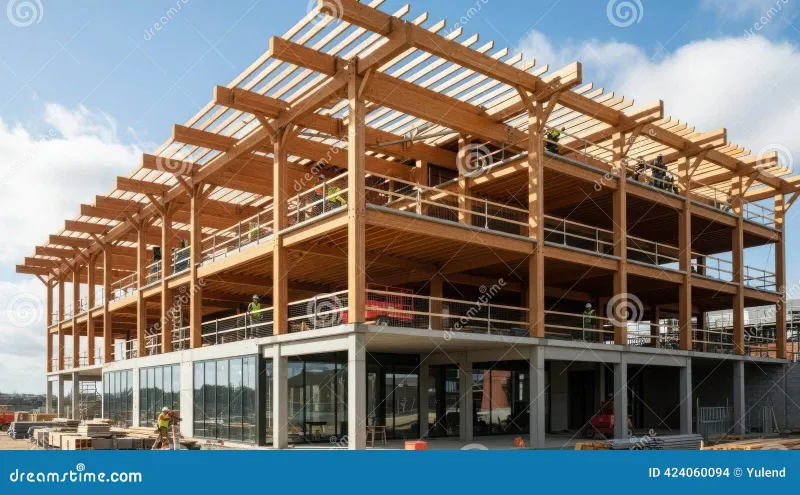
Photo: modern sustainable commercial building construction with timber and concrete structural frame, via thumbs.dreamstime.com
When most American business owners evaluate the sustainability of a building, they reach for the utility bill. Kilowatt-hours, therms, Energy Star scores — these are familiar numbers, printed and itemized each month. But the most consequential carbon accounting for many commercial buildings happens long before the first tenant flips a switch.
Embodied carbon — the greenhouse gas emissions generated by extracting raw materials, manufacturing products, transporting them, and assembling them on site — can represent more than half of a new building's lifetime carbon footprint. In high-performance buildings designed for efficiency, that share climbs even higher. A structure that sips electricity can still arrive with a massive carbon debt baked into its foundation.
Why the Ledger Tips Toward Materials
The logic is straightforward. Every improvement in operational efficiency reduces the importance of operational emissions, leaving embodied carbon as the dominant remaining contributor. A net-zero-ready office building in Denver or Austin may spend decades with minimal emissions from heating and cooling, while the cement in its slab and the steel in its frame emitted thousands of tons of CO2 in a single week of construction.
Timing matters, too. Operational emissions can be reduced retroactively — through better equipment, renewable energy contracts, or building controls. Embodied carbon cannot. Once the concrete is poured, those emissions are permanent. The ancient builders who raised tholos structures understood something modern developers are rediscovering: what you choose to build with is a decision you live with.
Learning to Read the Numbers
The primary tool for quantifying embodied carbon is the Environmental Product Declaration, or EPD. Think of it as a nutrition label for building materials, disclosing the carbon intensity of a product across its life cycle. EPDs are increasingly available for concrete mixes, insulation, glazing, steel, and virtually every major building component, and many manufacturers now publish them voluntarily to remain competitive.
With EPDs in hand, a whole-building assessment — typically conducted through a Life Cycle Assessment (LCA) following ISO standards — can produce a comprehensive picture of a project's upfront emissions. Several US-based tools make this accessible without specialized consultants: the Building Transparency platform's EC3 calculator, Autodesk's Insight, and One Click LCA all allow teams to compare design options before specifications are finalized.
For owners commissioning new construction, the practical sequence is simple: demand EPDs from your contractors, run a comparative LCA on at least two structural systems, and set an embodied carbon target in the same breath as your energy targets.
Where the Big Wins Hide
Three material categories typically dominate a building's embodied footprint, and each offers meaningful room for improvement.
Concrete is usually the largest single contributor. Because cement production releases CO2 both from fuel and from the chemical process itself, even modest changes matter. Specifying mixes with supplementary cementitious materials — fly ash or slag — can cut a slab's carbon intensity by 20 to 40 percent with no meaningful performance penalty. Emerging low-carbon cements are entering the US market as well.
Structural steel and framing offer a choice rather than a tweak. Steel produced in electric arc furnaces using scrap, much of it domestic, carries a far smaller footprint than traditional blast-furnace product. Mass timber, increasingly permitted under the International Building Code for mid-rise construction, can turn a building's frame from a carbon source into a carbon store.
Insulation and envelope materials reward scrutiny of the details. Some foam products carry outsized emissions from blowing agents; mineral wool, cellulose, and wood-fiber alternatives often deliver comparable performance at a fraction of the carbon cost.
Turning Data Into Certification Credit
Embodied carbon is no longer a side note in green building certification — it is a scoring pillar.
Under LEED v4.1, the whole-building LCA credit offers substantial points for demonstrating verified reductions against a baseline design, and EPD documentation earns additional recognition. The newer LEED v5 framework elevates carbon further, making it a central priority across rating categories. Meanwhile, programs like the International Living Future Institute's Zero Carbon certification and the Carbon Leadership Forum's emerging standards treat embodied emissions as a first-class metric.
State and municipal policy is following suit. Buy Clean California sets carbon intensity limits on public procurement, and cities including Denver, New York, and Portland have adopted or are studying embodied carbon requirements for new construction. Business owners who build to these standards today are, in effect, pre-complying with the regulatory direction of travel.
A Structural Decision, Not a Cosmetic One
There is a temptation to treat sustainability as a layer applied late in design — solar panels on the roof, recycled carpet in the lobby. Embodied carbon resists that framing. It is determined in the earliest structural and material decisions, often before a schematic is complete.
The practical takeaway for any business planning construction or a major renovation: bring carbon accounting to the first design meeting, not the last. Ask for EPDs. Request a comparative LCA. Set an embodied carbon budget alongside your financial one. The buildings that will matter in the coming decades are those whose entire story — from quarry to occupancy — was counted honestly from the start.