Round Before Green: Lessons from the Tholos for Today's Building Boom
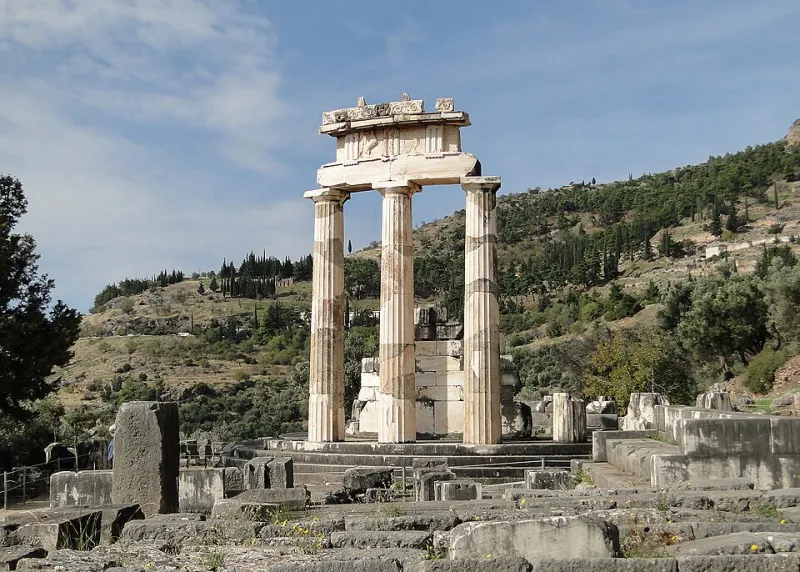
Photo: Bernard Gagnon, CC BY-SA 4.0, via Wikimedia Commons
Walk through the Sanctuary of Athena Pronaia at Delphi, and you will encounter one of antiquity's most elegant answers to a question we are still asking: how do you build something that works with its environment rather than against it? The tholos—a circular temple wrapped in a ring of Doric columns—was not designed with a sustainability checklist in hand. Yet it achieves, through pure architectural reasoning, many of the outcomes that today's certification frameworks reward.
For American businesses planning new construction, there is a lesson here worth sitting with. The most advanced green building strategies are often rediscoveries, not inventions.
The Geometry of Efficiency
Start with the shape itself. A circle encloses more area per unit of perimeter than any other form, which means a round building uses less wall material to create the same floor space. That is not a stylistic quirk; it is structural mathematics. Fewer surfaces mean less heat loss in winter, less heat gain in summer, and lower embodied carbon in the envelope itself.
Compare that to the rectilinear default of American commercial construction, where corners multiply, surfaces multiply, and with them, the energy budget. Modern parametric design tools now let architects quantify exactly what the ancient builders understood intuitively. Some of the most progressive projects in the US—from oval-shaped offices to curved mass timber pavilions—are quietly returning to the logic of the ring.
Passive Everything
The tholos worked hard without consuming a single watt. Its circular form allowed consistent solar exposure around the structure, while the colonnade created a shaded transitional zone—a thermal buffer that moderated the interior climate before the building itself had to. Openings positioned to catch prevailing breezes provided continuous natural ventilation. Light entered from multiple orientations, reducing the need for artificial illumination during daylight hours.
Translate that vocabulary into contemporary terms and you have passive cooling, daylighting, and thermal buffering—three of the highest-leverage strategies in any green building standard, from LEED to Passive House to the Living Building Challenge. The difference is that the Greeks achieved these outcomes without mechanical backup. Their design had to be right the first time.
Local Materials, Regional Character
There was no global supply chain in fourth-century BCE Greece. The Pentelic marble of a tholos came from nearby quarries, cut by local craftsmen, assembled with an economy of transport that modern logistics cannot match. The result was a low-carbon footprint by necessity—and a building that looked, unmistakably, like it belonged to its landscape.
US projects pursuing green certification increasingly recognize the value of this approach. Sourcing regional materials earns credits under LEED and reduces transportation emissions, but it also strengthens local economies and produces architecture with a genuine sense of place. A building in the Southwest that draws on regional stone and vernacular shading strategies will perform better and age more gracefully than one assembled from a generic national palette.
Durability as the Ultimate Sustainability Metric
Perhaps the deepest lesson is longevity. The best-preserved tholoi have stood for over two thousand years. Whatever else we say about sustainable construction, nothing outperforms a building that does not need to be rebuilt. Embodied carbon is only amortized over a structure's lifetime, and the longer that lifetime, the smaller the annual debt.
American commercial buildings too often are designed for thirty-year horizons, then demolished. Certification systems are beginning to weight durability and adaptability more heavily, and for good reason. Building for centuries—not decades—is the most radical sustainability statement a developer can make.
Looking Backward to Move Forward
None of this argues for literal imitation. A circular temple does not house a distribution center or a medical office. But the principle of the tholos—design in harmony with climate, material, and place before reaching for mechanical solutions—maps directly onto the highest tiers of modern green certification.
At Tholos Green, we take the name seriously. The ancient round temple reminds us that sustainability is not a technology you bolt on. It is a discipline of design, and it is very old. Businesses that internalize this principle early in their construction planning routinely find that green certification follows almost as a byproduct of getting the fundamentals right.
The forward path for sustainable building in the United States may not require inventing something new. Sometimes, the most innovative move is a careful look back—and the wisdom to build on it.