Shade, Charge, and Consent: The Case for Treating Parking Lots as Public Infrastructure
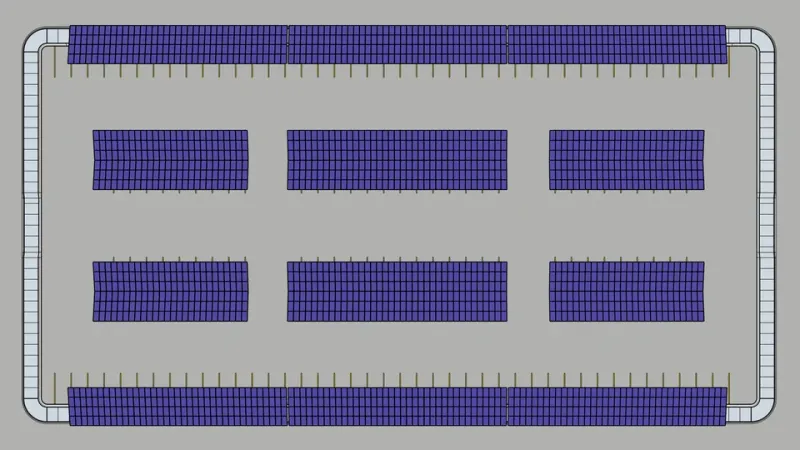
Photo: Wikideas1, CC0, via Wikimedia Commons
Drive through almost any American commercial corridor and you will pass, without noticing, one of the largest undeveloped land holdings in the country: the parking lot. It sits empty most of the day, absorbs sunlight into asphalt through the afternoon, and sheds stormwater into a municipal system that was not designed for the volume. It is, in almost every respect, a wasted asset.
A solar canopy changes that reading. Steel columns rise from the stalls, a photovoltaic roof spans the aisles, and the lot becomes a small power plant that also happens to shade the cars beneath it. That is the engineering story, and it is compelling. The harder story — the one that determines whether the project gets built — is about the people who park there, the utility that must interconnect it, and the neighbors who look at it every day.
The Asset Hiding in Plain Sunlight
The physical case for canopies is stronger than it looks on a napkin. Panels mounted above a lot operate at lower ambient temperatures than rooftop arrays with poor airflow, which helps yield. Bifacial modules can pick up reflected light from pale pavement. The structure itself is conventional work for any contractor who builds highway signage or carports, so the construction risk is well understood.
What must be engineered carefully is everything the brochure ignores: foundation design in soils that were compacted for vehicles rather than buildings, snow and wind loading, drainage that does not dump water onto adjacent stalls, clear heights for delivery vehicles, and the inviolable geometry of accessible parking. A canopy that shades a stall someone cannot enter is not an improvement.
Shade Is a Building System
Surface temperature is not a cosmetic concern. A shaded lot stays measurably cooler than an unshaded one, which reduces heat stress on people crossing it, on the vehicles parked in it, and on the building envelope it abuts. For retail and hospitality properties, that difference shows up in customer behavior on a July afternoon.
Then there is the water. A canopy is a roof, and a roof is a collection surface. With gutters and a downspout routing to a bioswale, a rain garden, or an infiltration bed, a canopy can reduce the volume leaving the site — useful where municipal stormwater permits under the MS4 program impose volume control obligations, and useful in its own right where paved area has been quietly contributing to local flooding for decades.
And it is a charging platform. Adding conduit and capacity during the initial build is inexpensive compared with trenching later. Owners who install level-two charging beneath the canopy, with load management that lets the array offset vehicle demand, tend to find that the stalls become among the most valuable assets on the property.
Interconnection Is the Real Project
The canopy is a construction project. The interconnection is an endurance event. In many regions of the United States, the queue for a distribution-level review stretches for months, and the study results may return with a requirement for a service upgrade that the site cannot physically accommodate.
Owners should decide early whether they intend a behind-the-meter system sized to on-site load, an export-capable system, or a front-of-the-meter arrangement. That choice determines which tariff applies, whether net metering or a successor program governs compensation, and how much of the output can be credited. Where export is limited, the design should be sized to load — and should anticipate that load will grow as electrified heating and vehicles arrive.
Smart inverters, export limits, and a candid conversation with the utility early in design will not eliminate the schedule risk, but they will prevent the most expensive kind of surprise: a completed array waiting months for permission to energize.
The Neighbors Have a Vote
Solar canopies fail for social reasons more often than technical ones. Glare reflected into a nearby office window. The loss of a favored tree. Construction noise during a retail tenant's busiest season. A couple dozen parking stalls unavailable for six weeks. A structure visible from a residential subdivision that was never told it was coming.
None of these objections is unreasonable, and all of them are cheaper to address before permitting than after. A useful practice is to treat the pre-application period as a genuine engagement exercise rather than a compliance formality: brief the adjacent property owners, show a rendering with a glare analysis, explain the construction schedule in plain language, and offer something concrete — public charging stalls, a commitment to preserve perimeter trees, or a landscape buffer on the exposed elevation.
Where the site serves a community with limited access to charging infrastructure, opening a portion of the canopy stalls to public use does more for the project's standing than any press release. It also creates a genuine public benefit argument that can travel to a planning commission or a utility regulator without embarrassment.
Underwriting Consent
Social license is not a line item, but it can be modeled as one. Add schedule allowance for stakeholder engagement. Budget for screening and landscaping. Budget for a slightly more expensive structure that respects sightlines. Budget for the possibility that a neighbor's concern will require a redesign in schematic design rather than in construction documents.
Owners who treat these as the soft costs of a hard project frequently find that they are, in fact, the critical path. Owners who treat them as part of the design brief often find that the project moves more quickly than expected, because nobody contests it.
The Tholos Test
The tholos was a circular building, which means it had no back. Every face was a front, and every face was designed to be seen. Commercial energy infrastructure faces the same test now. A parking canopy that generates clean electricity while igniting a neighborhood dispute is a half-built asset. One that shades cars, slows stormwater, charges vehicles, and leaves the neighbors feeling consulted rather than surprised is something closer to infrastructure — and infrastructure is what makes a business case durable.